
Olive Ridleys of Odisha
- How many species of sea turtles are there?
There are 7 species of sea turtles in the world, including leatherback, loggerhead, hawksbill, green and flatback turtles, and the two species of ridleys, olive and Kemp’s.
Five of these species are globally distributed and inhabit Indian waters i.e. all barring the flatback which is found only in Australia, and the Kemp’s ridley which is found in the North Atlantic and nests only on the east coast of Mexico.
- Which species of turtles nest in arribadas?
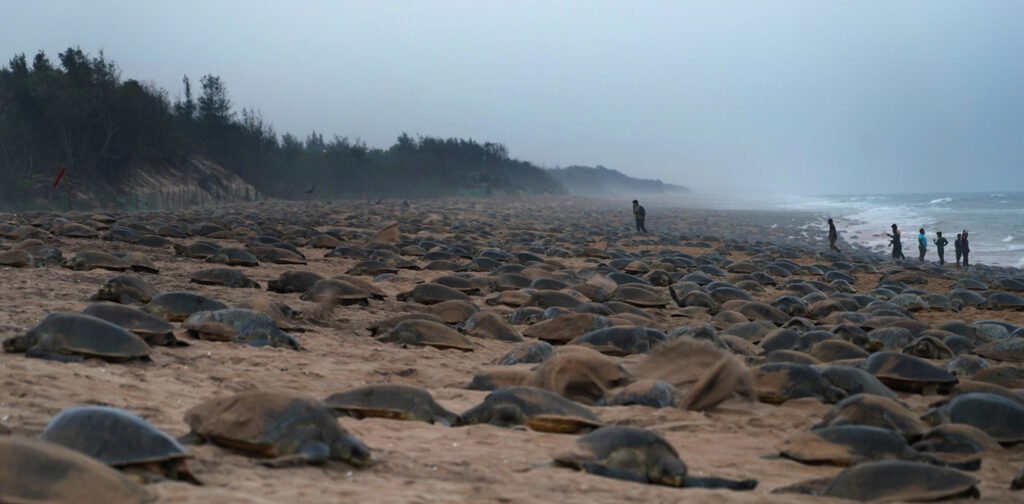
The two species of ridleys, Kemp’s and olive ridleys, also the smallest sea turtles, show mass nesting behaviour, known as arribadas. This is a Spanish word for arrival. In India, only olive ridley turtles show mass nesting behaviour
- Where do arribadas occur worldwide?
Major mass nesting beaches for olive ridley turtles occur at Gahirmatha and Rushikulya in Odisha on the east coast of India, and in Mexico, Costa Rica and Nicaragua on the Pacific coast of central America. Smaller aggregations are known from Panama, and were previously recorded in Suriname and French Guiana. New mass nesting beaches have also formed in Costa Rica and the Middle Andaman Islands
- Why do ridleys nest in arribadas?
The most popular hypothesis for this behaviour is the ‘predator satiation’ hypothesis. This suggests that, by nesting at the same time in the same location, predators are swamped by the numbers of turtles that nest, the number of eggs laid and eventually the hatchlings that emerge. If they nest solitary, they would be much more susceptible to predation, especially the eggs and hatchlings. In fact, olive ridleys lay shallower nests than other sea turtles as they are relatively smaller, and these are easily detected and dug up by a variety of predators. Even though they dig up each other’s nests during arribadas, the overall chance of avoiding nest depredation and hatchling predation is believed to be much higher when they nest synchronously, increasing their survival.
- Why is there variation in nesting from year to year?
Most sea turtles do not nest annually. Leatherback turtles may nest once in 2-3 years, while green and loggerhead turtles may nest even more infrequently. This is because they have to build up their reserves of energy to migrate enormous distances from feeding to breeding grounds. Even though some olive ridley turtles nest annually, many do not. Moreover, the number of clutches they lay during the season may vary. Given that not all the turtles in the population nest in a particular year or in a particular arribada, the sizes of these arribadas, and the nest total in a season is bound to vary. This year to year variation may not reflect changes in the overall population size, and long-term data (10 to 20 years) are required to determine if populations are increasing or decreasing.
Most importantly, the failure of the arribada in any given year means very little.
It does not mean that the population is declining or that protection agencies such as the Forest Department are not doing their job. Perhaps fewer turtles migrated during that year or that their nesting was more dispersed. Sometimes, they migrate to the nearshore waters, but do not mass nest. We still don’t know why.
- Are olive ridleys endangered worldwide?
Olive ridley turtles were once listed as Endangered in the IUCN Red List, but were redesignated as Vulnerable in 2008, which is a lower category of threat. Since then, it has been recognised that many populations are stable or increasing such as the population on the east coast of India. New arribada beaches have emerged in many places. Overall, in an article in the State of the World’s Turtles (SWOT) in 2021, K. Shanker and co-authors concluded that olive ridleys were widespread and abundant, and doing well at a global scale.
- Are olive ridleys threatened or declining in India?
Olive ridley turtles nest solitarily on both west and east coasts of India and the Andaman and Nicobar Islands. Monitoring by NGOs and the Forest Department on the east and west coasts of the mainland suggests that the number of nests at these beaches has increased. The occurrence of a new arribada beach in the Andaman Islands is a positive sign as well
With the support of the Forest Department, the Indian Institute of Science and Dakshin Foundation, Bangalore have been monitoring the mass nesting beach at Rushikulya since 2007. This nearly two decade long dataset shows an increasing nesting trend, suggesting the population here is growing. In 2025, Rushikulya saw two arribadas – the first was the largest ever recorded here, with over 500,000 nests. With two large arribadas in Rushikulya, and one in Gahirmatha, there were about 1 million nests in Odisha last year.
In fact, increased sea turtle mortality can simply derive from their increased in population size, which results in higher densities in nearshore waters. Efforts by the Forest Department and Coast Guard have helped reduce bycatch over the last decade. While turtle deaths in fishing nets still occur, this does not seem to be drastically affecting the population trends.
- What are the major threats to ridleys in India?
While olive ridley turtle populations do appear to be increasing, they still face threats in the medium-term from coastal development, habitat loss and climate change. Unplanned development can lead to the erosion and loss of important nesting beaches while maritime activities can affect their feeding and breeding habitats. Climate change leads to an increase in air, and therefore sand, temperatures, resulting in female biased sex ratios, which can affect population health. Finally, there are potential threats from pollution such as microplastics and heavy metals.
- How can we reduce the mortality from fisheries?
During the breeding season, olive ridley turtles are typically found within 4 to 5 km of the coast. Most states already have marine fishing regulations that proscribe fishing by large mechanised boats within these nearshore waters. ALL that is required is the implementation of these laws in all the states. In reality, no additional regulations are required to protect breeding sea turtles, even near mass nesting beaches.
It should be noted that these laws were passed in the 1980s to protect these nearshore habitats from bottom trawling and to safeguard the livelihoods of traditional and artisanal fishermen. Thus, the implementation of these laws can protect ecosystems, marine resources and the livelihoods of small-scale fishing communities. As a side effect, sea turtles will also be protected.
Thus, we can go from “incidental catch” to “incidental conservation”.
- Should we stop all fishing near the mass nesting beaches?
Absolutely not. As mentioned above, fisheries laws must be implemented in nearshore waters. However, most small-scale fishing has little impact on sea turtle populations. In fact, as we have seen, even the mortality caused by mechanised fishing has not affected this population to a large extent. Restricting access to fishing grounds for small-scale fishers and affecting their livelihoods is both unnecessary, unethical and wrong.
In Odisha, the area of the no-fishing zones off the coasts of Devi and Rushikulya is much larger than the area occupied by sea turtles during the breeding season, and poses unnecessary restrictions on the fishing communities and an unreasonable burden on enforcement agencies.
Most of the regulations have resulted in restrictions on fishing that affect traditional fishermen and create conflicts and antagonism towards turtle conservation in general. These restrictions on traditional fishing are unnecessary, have negative impacts on already marginalised communities, and do not really benefit turtles in a significant way. We must stop employing protection measures that have negative effects on poor people.
- How can TEDS help?
Though required by some international policies and laws, the implementation of MFRAs makes TEDs completely redundant since most of the turtles are within nearshore waters during the breeding season. TEDs have a number of additional problems:
(a) they are very hard to use and maintain properly even with a lot of training,
(b) they are very easy to disable during operation, and
(c) most importantly, even if used perfectly, a small catch loss represents a major share of their income, which is not understandably acceptable to most fishers.
TEDs are both a white elephant and a distraction. They are hard to implement, impose too much cost, and are wholly unnecessary if MFRAs are implemented.
- How can I help?
Overall, olive ridley turtles are not currently endangered or immediately threatened by fisheries mortality, but may be affected by habitat loss and climate change in future.It is important to address these threats through planning and management and not indulge in hype and knee-jerk reactions to see
Most sea turtle conservation measures ignore the fact that the conservation of whole marine ecosystems is the larger goal. We must ensure that our management policies benefit local fishers. We cannot expect coastal fishers to bear the brunt of change while the rest of society remains unaffected. We can do this by making them partners in conservation and in the decision making processes.
You can help by:
- Promoting and spreading knowledge and evidence-based ideas about sea turtle conservation
- Supporting a more holistic approach to conservation that takes into account charismatic species like sea turtles and sharks, but also their habitats and the innumerable other species that occupy coastal and marine ecosystems
- Acknowledging the importance of human welfare, especially for small-scale fishers and other marginalised communities.
Please volunteer and engage with organisations to learn more about what they do and support their activities.
Recent Comments